Nein Gestalt
A reverb for rooms that cannot exist.
Most reverbs are a network of delays tuned until they sound like a room. Nein Gestalt does not tune anything. It fills a space with air and computes how sound waves move through it, cell by cell, thousands of times a second, on the Mac's GPU. The tail you hear is what that space does to your sound.
The space is the part that cannot exist. Its cells are joined in ways no building could be: a staircase whose top step leads back to the bottom, a room that comes back mirrored every time you walk around it, a floor tiled in a pattern that never repeats. The waves follow those joins, so the reverb has resonances and echoes no real room has.
What it sounds like
Bright and glassy rather than warm. Each space rings at its own set of pitches, and those resonances color everything you put through it: a plucked line sits inside a cloud of its own tail, a drum hit leaves a metallic ring that hangs on between beats.
The four spaces differ the way rooms do. The staircase is the brightest and most even. The mirrored rooms ring higher and thinner. The Klein bottle has no walls at all and is the wettest. The rhombus tiling is rounder and lower, with a deep boom under it.
Working with it
Geometry picks the space. It is the biggest change you can make, so start here. You can switch while playing: the new space starts empty and the old one fades out over a fifth of a second.
Scale sets the size of each cell, from 2 to 60 centimeters, and so the size of the whole space, from about a third of a meter to nearly ten meters across. Small spaces ring high and short; large ones bloom low and slow. It changes while playing too.
Absorption is how much of the sound's energy the air takes every 10 milliseconds, and so how long the tail lasts. At the default it rings for about two and a half seconds. Higher settings shrink the tail to almost nothing.
At zero nothing is absorbed, and you can keep playing into the space. Each space can only hold so much sound, so instead of building up without end the level settles, and when you stop playing the space keeps ringing at that level for as long as you leave it.
Mix is the dry/wet balance. The dry signal is delayed to line up with the reverb, so the two stay in time.
The display
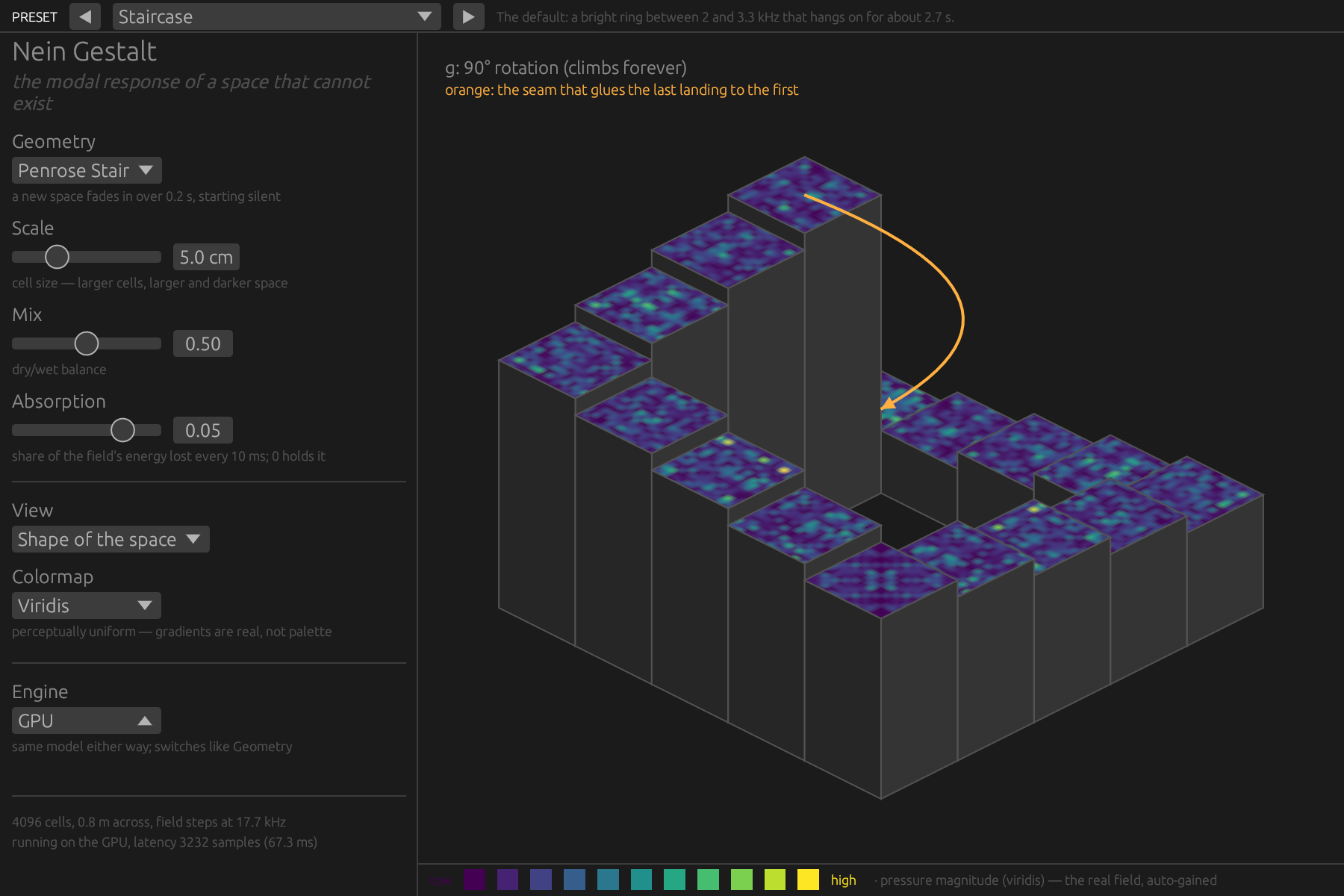
The display is the sound field itself: every cell of the space, colored by how much pressure is in it right now, drawn straight from the simulation on the GPU. When you play, you see the wave leave the source and spread through the space. The display adjusts its own brightness, so the field stays visible as the tail dies away.
By default the display shows the shape of the space: the staircase built as four flights of solid steps around a square, the box as stacked floors, the Klein bottle as a closed ring, each surface colored by the live field, with the seam that joins the last landing to the first drawn in orange. The tiling is shown as its own floor plan. A Flat view lays every landing side by side instead. Four color maps are available, and the view you choose is saved with your project.
Demos
Rendered offline with the plugin's own engine, with no other processing. The source sounds were synthesized for these demos.
-
Penrose stair
Every note keeps ringing in a glassy cloud, so the melody sits inside its own tail. -
Penrose rhombus
A halo as loud as the chord itself, carrying each chord into the next. -
Klein
A metallic ring after every hit that hangs on between beats. -
Absorption
The same two bars four times. Each time the absorption goes up, and the tail shrinks from about six seconds to almost nothing. -
Infinite stair
The whole phrase played into a staircase that loses nothing. The level settles instead of piling up, and when the playing stops the space keeps ringing at that level.
The editor
The spaces
| Penrose Stair | Every step goes up, yet four flights bring you back to the start, as in Escher's staircase. Glassy and bright. |
|---|---|
| Necker Reversal | The top joins the bottom mirrored, so front and back swap on every lap. A higher, thinner ring. |
| Klein Bottle | The floor wraps around and comes back mirrored. No walls anywhere. Metallic and the wettest of the four. |
| Penrose Rhombus | A floor tiled in a golden-ratio pattern that never repeats. Dense, irregular resonances, rounder and lower, with a deep boom. |
Parameters
| Geometry | Which impossible space. |
|---|---|
| Scale | Cell size, 2 to 60 cm. Sets the size of the space and so its pitch. |
| Absorption | Fraction of the energy the air takes every 10 ms. Sets the tail length; zero holds the sound indefinitely. |
| Mix | Dry/wet balance. |
| Engine | GPU, or a CPU version of the same simulation with lower latency, for Macs where the GPU is busy. |
Presets
| Staircase | The default. A bright ring between 2 and 3.3 kHz that hangs on for about 2.7 seconds. |
|---|---|
| Tall Staircase | The same stairs, 6.4 meters across. A hollow resonance near 250 and 400 Hz. |
| Endless Staircase | Absorption at zero. The space keeps what you play into it and holds it at a steady level. |
| Necker Box | The same decay with a higher, thinner ring. |
| Short Necker Box | Small cells. A short, high ring, gone in a quarter of a second. |
| Klein Bottle | The wettest space. A metallic ring that sings between notes. |
| Large Klein Bottle | Nine meters across. A dark bloom with resonances near 100 and 250 Hz. |
| Tiling | A rounder, lower tail near 1.2 kHz with a boom near 53 Hz. |
| Large Tiling | A halo near 200 Hz, with overtones at 500 and 800 Hz. |
| Slow Tiling | A low tone louder than the dry sound, fading over about nine seconds. |
Beta soon
Nein Gestalt is nearly ready for testers. Beta builds go out to the waitlist in groups. To join, send one line saying which DAW and which Mac you use.
Join the waitlistRequirements
| System | macOS 11 Big Sur or later, on Apple Silicon. Intel Macs are not supported. |
|---|---|
| Formats | CLAP, VST3, and Audio Unit (AUv2). |
| GPU | Runs on the Mac's GPU through Metal. The GPU engine adds about 60 ms of latency at 48 kHz and the CPU engine about 22 ms, reported to the host so it can compensate. Switching spaces never changes it. |
| Output | Mono or stereo in. The reverb is one listening point in the space, so it is the same in both channels. |
| Windows | Not supported. macOS only. |