Hanoi's Voice
A spectral delay driven by a Tower of Hanoi puzzle.
Hanoi's Voice splits your sound into frequency bands and gives each band its own echo. Each band is also a disk in a Tower of Hanoi puzzle, and each peg is a place in the stereo field.
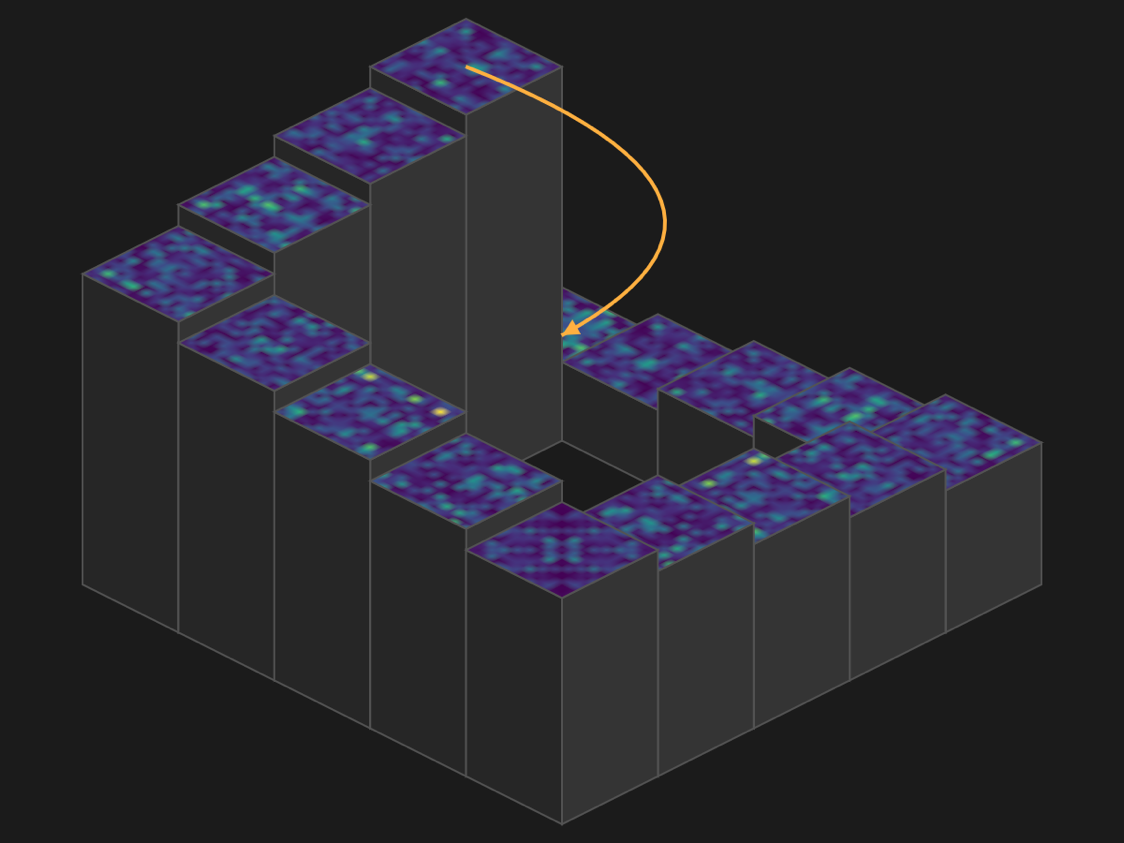
The plugin plays the puzzle out move by move. When a disk moves to another peg, that band's echo moves with it, and a trail of the echo lingers where it was. Small disks are the high bands and move often. Large disks are the low bands and move rarely; the largest moves once in a full solution. So the top of the sound skitters around the field while the bottom shifts slowly underneath it.
There is no LFO or random generator behind the movement. The order of moves is the puzzle's own solution, so it is the same every time, and it takes long enough to finish that it does not sound like a loop.
What it sounds like
At the default settings it is a delay whose echoes are split by pitch and spread across the field: a plucked line comes back as a scatter of repeats, each at its own place and time. High bands echo sooner and low bands later.
Turn up Texture and the echoes break into overlapping grains, and further up pitch-shifted copies start to appear, a fifth or an octave or two away. Turn up Feedback and the echoes regenerate until the sound almost holds still. Turn up Motion and the puzzle runs faster, so the bands trade places more often.
Working with it
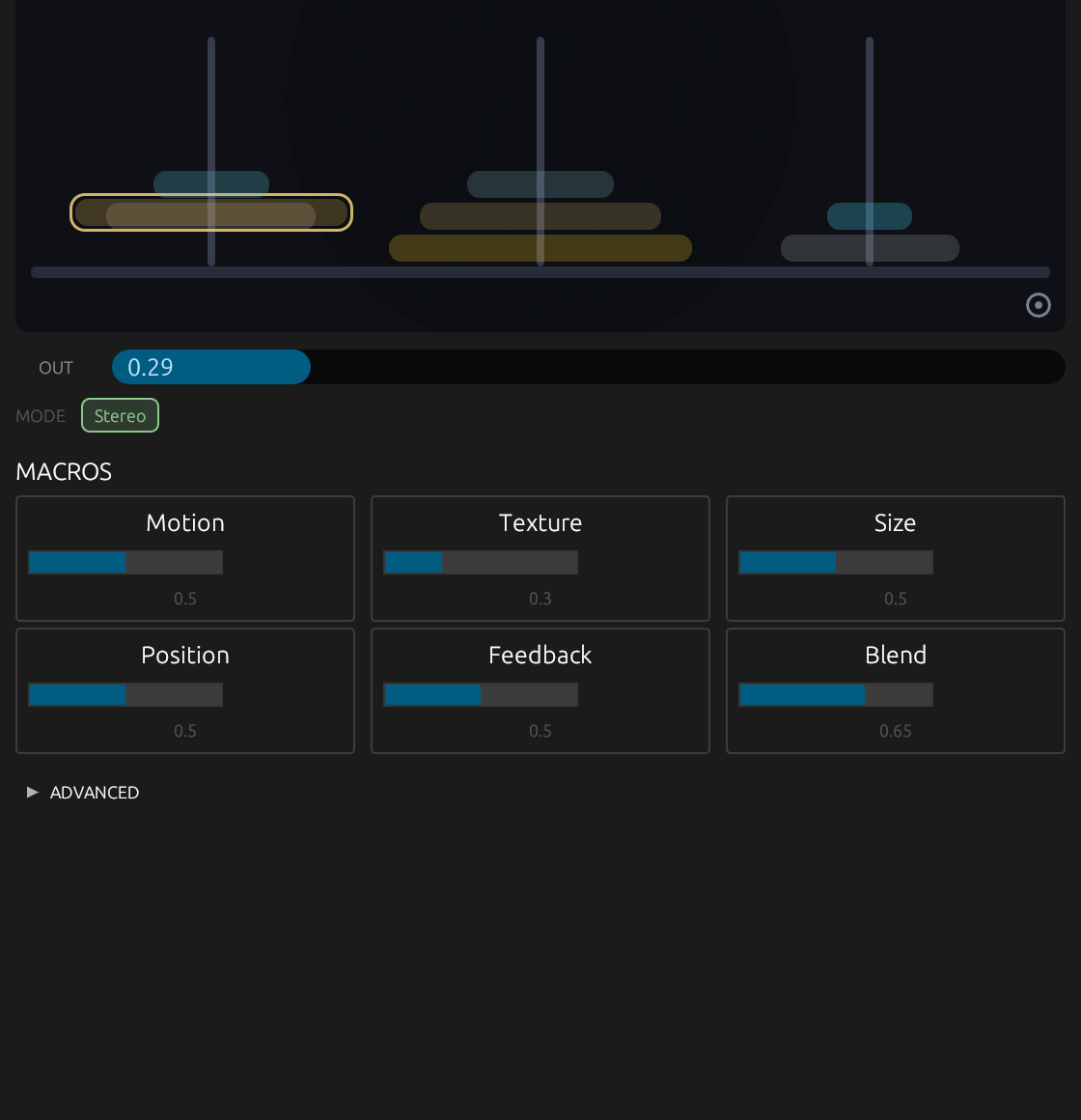
Six controls are always on screen, and they cover most of what the plugin does.
Motion sets how fast the puzzle plays. At the middle it makes about two moves a second. Turning it down slows that to a quarter, and turning it up makes it four times faster.
Texture breaks the echoes into grains. Low is a clean delay. From about 60 percent up, pitch-shifted ghosts join in, and near the top there are many of them.
Size sets the grain length, from 20 milliseconds to two seconds. Short grains sound like a stutter; long ones like smeared repeats.
Position sets where in the delay buffer the grains read from, so it moves the grains earlier or later in time.
Feedback is how much of each echo comes back around. Near the top the echoes pile up until the sound nearly freezes, and the bands start to bleed into each other.
Blend is the dry/wet balance.
Under Advanced is the structure of the puzzle itself: how many disks (bands) and pegs (places), how the bands are spaced, the shortest and longest echo, and how the pegs are laid out in the field. Changing the number of disks or pegs changes the puzzle, and the plugin can keep the current positions, start over, or reseed.
The display
The tower view is drawn from the live state of the audio, once per block. Each disk is one band, colored from cool for the low bands to warm for the high ones, and it glows with that band's actual level. The disk that moves next lifts and flashes before it goes. A readout shows how many moves have been made, the size of the puzzle and which disk is next.
Below it, an output meter shows the level, and a mode chip shows whether the plugin is running in stereo or in B-format.
Demos
Rendered straight from the plugin with no other processing. The source sounds were synthesized for these demos.
-
Default settings
Each band's echo steps across the stereo field as the puzzle plays out. -
High motion
The puzzle solves about four times faster, so the echoes jump between left, center and right much more often. -
High texture
The echoes broken into overlapping grains. -
High feedback
The echoes feed back and pile up until the sound nearly freezes.
The editor
Parameters
| Motion | How fast the puzzle plays, from a quarter to four times the move rate. |
|---|---|
| Texture | Grain density. High settings add pitch-shifted ghosts. |
| Size | Grain length, 20 ms to 2 s. |
| Position | Where in the delay buffer the grains read. |
| Feedback | Regeneration, up to a near freeze. |
| Blend | Dry/wet balance. |
| Structure | Disks (1 to 24 bands), pegs (2 to 8 places), move rate, how differently the bands behave, and what happens when the puzzle size changes. |
| Band filters | Band spacing (Bark, Mel, ERB, octave, third octave, equal-tempered or log), lowest and highest band, and filter sharpness. |
| Delay | Shortest and longest echo (up to 4 seconds), how widely the bands spread between them, and an option to lock echo times to the moves. |
| Disk shaping | Level and drive per band, tilted from the low bands to the high ones. |
| Pegs | Ping-pong, a boost on each move, splicing, width, binaural panning, and how much new input reaches the echoes. |
| Output | Output level, and stereo or B-format. |
Presets
Seventeen, in six groups.
| Vocal | Inner Voice, Choir Ghost, Whispered Double. Doubling and ghost choirs for a voice. |
|---|---|
| Sound design | Granular Rain, Spectral Shatter, Machine Dream. Small grains, sharp bands and drive. |
| Spatial | Cathedral Dust, Slow Nebula, Hollow Bell. Long echoes, slow moves, wide fields. |
| Rhythmic | Ping Lattice, Staircase, Pendulum Bands. Moves and echoes locked into steps. |
| Subtle | Gentle Halo, Air Movement, Soft Doubler. A little movement under the dry sound. |
| Extreme | Runaway Tower, Total Collapse. Big puzzles, fast moves, feedback near the top. |
Beta soon
Hanoi's Voice is nearly ready for testers. Beta builds go out to the waitlist in groups. To join, send one line saying which DAW and which Mac you use.
Join the waitlistRequirements
| System | macOS 11 Big Sur or later, on Apple Silicon. Intel Macs are not supported. |
|---|---|
| Formats | CLAP, VST3, and Audio Unit (AUv2). |
| Output | Stereo in every format. In CLAP hosts it can also output three-channel first-order B-format (W, X, Y) on a three-channel bus. |
| Sample rates | Up to 192 kHz. The longest echo is 4 seconds at 44.1 or 48 kHz, about 2.7 seconds at 96 kHz and about 1.4 seconds at 192 kHz. |
| Windows | Not supported. macOS only. |